← All News

The Case for Removing Barriers in Illinois Community Solar
Our Comments on the Illinois Shines 2026-27 Program Guidebook
By Jason Kaplan
Illinois Shines has become one of the most successful consumer energy programs in the country — 70,000 participants, a 99.9% satisfaction rate, and meaningful structural improvements like net crediting that have reduced consumer risk to historic lows. Yet the enrollment process remains burdensome, particularly for the low- and moderate-income households who stand to benefit most.
PowerMarket has submitted formal comments to the Illinois Power Agency urging the Agency to let its own data drive policy. The current Disclosure Form framework was designed for a different era — one defined by bad actors and complex retail supply products. Community solar is neither. It is a simple, guaranteed-savings product with no installation, no contracts, and no risk, and the rules should reflect that.
We outline the following key issues and proposals in our comments:
Dear Illinois Power Agency and Illinois Shines Team:
We appreciate the opportunity to provide comments and feedback on the draft of the 2026-27 Program Year Illinois Shines Program Guidebook (“Guidebook”) and the 2026 Program Year Customer Protection Handbook (“Handbook”). We understand and appreciate the Illinois Power Agency’s (“Agency”) duty to ensure the protection of the consumer within Illinois Shines (the “Program”). However, as the Program has matured, it is critical that the Agency adopt an evidence-based approach to consumer protection. Program and consumer protection requirements must be calibrated to actual, demonstrated risks, rather than theoretical concerns. The Agency now has seven years of program data, including detailed complaint tracking, and this data should serve as the foundation for any regulatory updates. The Agency must now internalize its own data and real-world program outcomes and adjust the rules accordingly. Regulatory requirements should be proportional to demonstrated harm. Where risk is low, flexibility should increase, especially where the benefit to the consumer, namely Illinois’ low-and-moderate income households, is so significant. By easing some of the entrenched consumer protection requirements, the Agency can unlock significant participation by these marginalized communities without compromising the protections it desires to ensure.
Community solar is an exceptional energy program. Illinois households can receive guaranteed savings without any installation, without changing suppliers, and without any long-term obligation or risk. The Program got better in 2025 with the implementation of Community Solar Subscription Billing (“CSSB”) otherwise known as utility consolidated billing or net crediting. This structural improvement fundamentally changed the consumer risk profile of the product. By eliminating the need for out-of-pocket payments for bill credits, the Program removed one of the primary historical barriers to participation, particularly for low- and moderate-income households. This improved mechanism has also eliminated the need for Approved Vendors and Designees to collect sensitive subscriber payment details, eliminating the risks associated with requesting and storing this data. Now that no payment details are required ever, participation is more accessible and consumer risks are lower than ever.
However, despite these meaningful improvements, a significant problem remains: enrolling in community solar in Illinois is harder than it needs to be. Unnecessary barriers to entry persist, and the consumer protection framework has not evolved in light of the Program’s evolution and the Agency’s own data.
I. The Data Proves Program Compliance
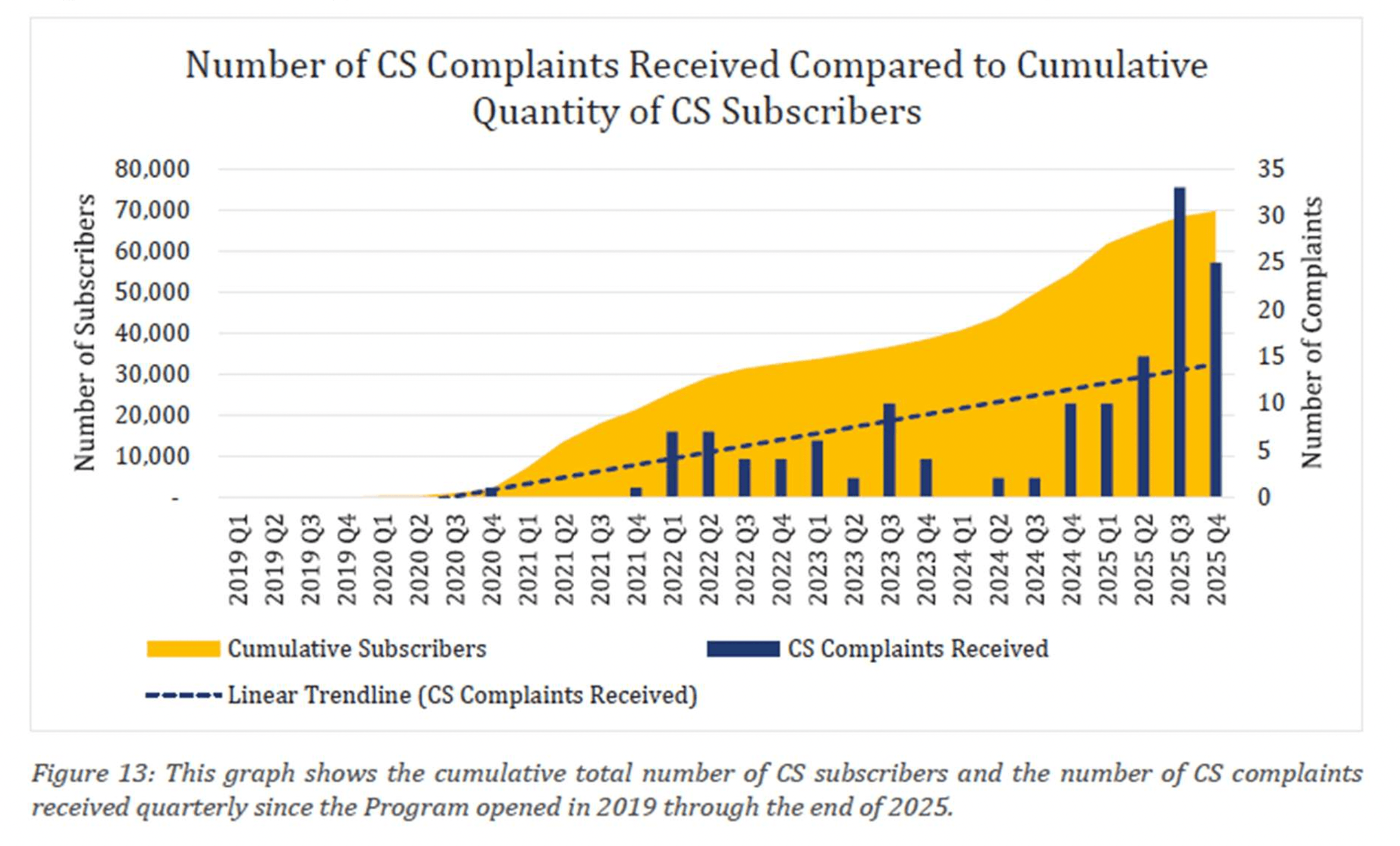
In 2025, the Program administrator received 80 complaints from community solar subscribers out of an estimated 70,000 participants per its recent Complaint Report.1 This represents a 0.1% complaint rate. Stated differently, more than 99.9% of community solar participants did not submit a complaint to the Agency. This is an extraordinary outcome for any consumer-facing program, let alone a retail energy program that has inherent complexities. And these are just unsubstantiated complaints, not actual Program violations or wrongdoing. While the Agency has not distinguished community solar complaints from all complaints when sharing sub-status of complaints resolved or closed, we expect that the number of actionable violations to be significantly less than 80. A complaint/violation rate of this magnitude is not indicative of a program requiring heightened procedural controls—it is indicative of a market with a good product and good actors administering it.
The Agency’s own report demonstrates that 83% of Approved Vendors and Designees had zero complaints filed against them and the majority of complaints were concentrated among a small subset of actors. The historic data also tells a meaningful story, that as the market has grown substantially, the total number of complaints made by participants remains marginal. The Agency acknowledges this and notes that “[t]his trend likely indicates that although there are consumer protection and customer service issues within the market, these issues are not widespread across all entities participating in the Program.”2 The Agency “also suggests that Program requirements and consumer protection efforts may have a positive deterrent effect on problematic activities.”3 While there may be some truth to this suggestion, the Agency must also acknowledge that community solar is a product devised to have limited risk and cause for complaint. It is the fundamental features of community solar, i.e. guaranteed monthly savings, no additional payment, no installation, no long-term contracts, no penalties or fees, no change to supplier, and no impact to balance billing and PIPP (now that this has been addressed with Ameren), which results in these low complaint numbers compared to those for DG. This distinction must be recognized.
II. Current Disclosure Form Requirements Do Not Address Actual Consumer Harms
The Agency’s 2025 Complaint Report provides that the most notable complaints made against community solar Approved Vendors and Designees relate to “slamming” or alleged enrollment without customer consent. While these complaints should be taken seriously, the fact that all of these subscribers “signed” a Disclosure Form (whether they remember doing so or if it was done by a nefarious agent) illustrates the fact that a Disclosure Form does not prevent bad actors. To be clear, we are fully supportive of the use of Disclosure Forms under the Program, but how such Disclosure Forms must be digitally generated and the inflexibility in adjusting such forms after creation creates unnecessary frictions that have no bearing on limiting Program non-compliance. Bad actors will violate Program rules, and the Agency has full authority to act accordingly. The appropriate response to Program non-compliance and violations are targeted enforcement, strong penalties, and continued oversight of problematic actors, not maintaining Program rules that increase friction for compliant participants.
We ask the Agency to consider two competing risks: 1. The risk of consumer harm from insufficient protections; and 2. The risk of consumer exclusion due to unnecessarily burdensome requirements. Low- and moderate-income households are disproportionately impacted under the current Disclosure Form framework in Illinois Shines (Please note that we appreciate that low- and moderate income households are assumed to be predominantly enrolled in ILSFA, however the award of Low Income Communities Bonus Tax Credit (Category 4) to Illinois Shines projects necessitates the enrollment of such low-income households in those projects). Since the Disclosure Form process is principally digital-based, the process assumes subscribers have email addresses, possess digital literacy, and can manage digital contracts and execute electronically. These assumptions are not valid for a meaningful portion of our target communities and making the execution of Disclosure Forms in this manner a prerequisite, creates undue burden. To be clear, we are fully aware that there are other ways to enable a subscriber to execute a Disclosure Form, including by wet signature, but doing so can be a very time consuming and burdensome process. Just because it is possible, does not make it efficient or a positive customer experience.
The Agency already administers materially different community solar Disclosure Form processes across its programs, providing greater flexibility under ILSFA than Illinois Shines, despite ILSFA exclusively serving the most sensitive populations. Under Illinois Shines, the Disclosure Form functions as a precondition to enrollment, and must be uniquely generated, executed, and traceable prior to a customer being submitted into the portal—effectively requiring a unique Disclosure Form ID tied to each customer at the outset.4 Under ILSFA, the Disclosure Form is a standardized disclosure document, not a system-generated compliance document. ILSFA subscribers execute Disclosure Forms before, but contemporaneously, with the subscriber agreement within an Approved Vendor or Designee’s own enrollment portal. Disclosure Form IDs are only assigned after customer data is submitted into the program systems. The Illinois Shines approach creates greater enrollment friction, more administrative burden and greater subscriber drop-off without any evidence of improved subscriber outcomes. To that end, we strongly request that the Agency adopt the more flexible administrative approach under ILSFA to Illinois Shines as such adjustment would materially improve subscriber enrollment without diminishing consumer protections.
III. Specific Requested Guidebook Revisions
We appreciate the Agency for incorporating stakeholder feedback into the draft 2026-27 Guidebook, namely the revisions that provide increased flexibility for subscription sizing without requiring a new Disclosure Form to be signed. These updates represent a meaningful and practical improvement that will enhance customer experience and program administration. This edit appropriately recognizes the dynamic nature of customer usage and that the customer’s subscription size should not be unduly fixed despite the customer changes in their usage. However, customer usage is not the only variable that should reasonably necessitate an adjustment in subscription size that shouldn’t require Disclosure Form re-execution. For example, the customer’s bill spend, a change in the project’s production, and a change in the utility’s price to compare, are all factors that can impact the underlying value proposition. These variables should be included alongside changes in customer usage as exemptions to new Disclosure Form re-execution.
Beyond that language, we wish to provide the Agency with suggested redlines to the Community Solar Disclosure Form Section in the Guidebook. We believe these edits align better with the ILSFA Disclosure Form requirements and provide a meaningful balance between customer experience and consumer protection.
Community Solar Disclosure Form
The current enrollment process for Illinois Shines contains administrative requirements that create unnecessary friction. The following is a summary of the changes we are proposing to the Community Solar Disclosure Form process. These revisions are aimed at simplifying enrollment, expanding accessibility, and modernizing the framework to reflect how the program operates today, without compromising consumer protections.
PowerMarket appreciates the Agency’s efforts to ensure strong consumer protections within the Program. We want to operate under program rules that punish the violator and recognize the good actor. We hope these comments reflect PowerMarket’s deep care and commitment to the subscriber and our suggestions are in the interest of delivering the incredible financial benefits this program provides to the greatest number of Illinois households.
The Agency now has sufficient data and experience to recalibrate its approach to community solar. The current framework may have been appropriate in the early days of the program due to the history of bad actors and complaints in the alternative retail supply market. But community solar is not retail supply, and it is not DG. The Agency must now take this evidence and adjust the framework to be representative of the demonstrated risk. We respectfully urge the Agency to adopt language to the Guidebook and Handbook to allow a more flexible approach to Disclosure Forms, allowing for greater ease and access, particularly to low- and moderate-income households, while still preserving consumer protection safeguards.
Thank you for the opportunity to comment. If you have any questions regarding these comments, please reach out to me at Jason.kaplan@powermarket.io.
Sincerely,
Jason Kaplan, Esq.
President and Chief Legal Officer
PowerMarket
1Illinois Power Agency, Consumer Complaints & Disciplinary Actions Annual Report 2025 (Illinois Shines & Illinois Solar for All) at p. 36 (Feb. 27, 2026).
2Id. at 42. (“It is a positive sign that the share of Approved Vendors and Designees with complaints filed against them continues to be relatively small, even as the Program continues to expand in size, application submissions, customer base, and number of entities participating.”)
3Id.
4See Illinois Shines Program Guidebook (2025–26), Section 5 (Project Applications) at 118.
PowerMarket has submitted formal comments to the Illinois Power Agency urging the Agency to let its own data drive policy. The current Disclosure Form framework was designed for a different era — one defined by bad actors and complex retail supply products. Community solar is neither. It is a simple, guaranteed-savings product with no installation, no contracts, and no risk, and the rules should reflect that.
We outline the following key issues and proposals in our comments:
- 99.9% of participants filed no complaint in 2025. The Agency's own data supports the easing of procedural controls.
- Two risks must be weighed equally: consumer harm from insufficient protections, and consumer exclusion from requirements that are disproportionate to the actual risk.
- The current Disclosure Form process assumes digital access that many low- and moderate-income households do not have. This creates a barrier to enrollment that is not justified by program outcomes.
- ILSFA, (the Agency's own low-income program), already operates under a more flexible Disclosure Form process. We are asking Illinois Shines to adopt the same standard.
- We propose six specific revisions to the Disclosure Form process: timing of execution, form generation, language access, post-generation edits, e-signature requirements, and ID assignment.
Dear Illinois Power Agency and Illinois Shines Team:
We appreciate the opportunity to provide comments and feedback on the draft of the 2026-27 Program Year Illinois Shines Program Guidebook (“Guidebook”) and the 2026 Program Year Customer Protection Handbook (“Handbook”). We understand and appreciate the Illinois Power Agency’s (“Agency”) duty to ensure the protection of the consumer within Illinois Shines (the “Program”). However, as the Program has matured, it is critical that the Agency adopt an evidence-based approach to consumer protection. Program and consumer protection requirements must be calibrated to actual, demonstrated risks, rather than theoretical concerns. The Agency now has seven years of program data, including detailed complaint tracking, and this data should serve as the foundation for any regulatory updates. The Agency must now internalize its own data and real-world program outcomes and adjust the rules accordingly. Regulatory requirements should be proportional to demonstrated harm. Where risk is low, flexibility should increase, especially where the benefit to the consumer, namely Illinois’ low-and-moderate income households, is so significant. By easing some of the entrenched consumer protection requirements, the Agency can unlock significant participation by these marginalized communities without compromising the protections it desires to ensure.
Community solar is an exceptional energy program. Illinois households can receive guaranteed savings without any installation, without changing suppliers, and without any long-term obligation or risk. The Program got better in 2025 with the implementation of Community Solar Subscription Billing (“CSSB”) otherwise known as utility consolidated billing or net crediting. This structural improvement fundamentally changed the consumer risk profile of the product. By eliminating the need for out-of-pocket payments for bill credits, the Program removed one of the primary historical barriers to participation, particularly for low- and moderate-income households. This improved mechanism has also eliminated the need for Approved Vendors and Designees to collect sensitive subscriber payment details, eliminating the risks associated with requesting and storing this data. Now that no payment details are required ever, participation is more accessible and consumer risks are lower than ever.
However, despite these meaningful improvements, a significant problem remains: enrolling in community solar in Illinois is harder than it needs to be. Unnecessary barriers to entry persist, and the consumer protection framework has not evolved in light of the Program’s evolution and the Agency’s own data.
I. The Data Proves Program Compliance
In 2025, the Program administrator received 80 complaints from community solar subscribers out of an estimated 70,000 participants per its recent Complaint Report.1 This represents a 0.1% complaint rate. Stated differently, more than 99.9% of community solar participants did not submit a complaint to the Agency. This is an extraordinary outcome for any consumer-facing program, let alone a retail energy program that has inherent complexities. And these are just unsubstantiated complaints, not actual Program violations or wrongdoing. While the Agency has not distinguished community solar complaints from all complaints when sharing sub-status of complaints resolved or closed, we expect that the number of actionable violations to be significantly less than 80. A complaint/violation rate of this magnitude is not indicative of a program requiring heightened procedural controls—it is indicative of a market with a good product and good actors administering it.
The Agency’s own report demonstrates that 83% of Approved Vendors and Designees had zero complaints filed against them and the majority of complaints were concentrated among a small subset of actors. The historic data also tells a meaningful story, that as the market has grown substantially, the total number of complaints made by participants remains marginal. The Agency acknowledges this and notes that “[t]his trend likely indicates that although there are consumer protection and customer service issues within the market, these issues are not widespread across all entities participating in the Program.”2 The Agency “also suggests that Program requirements and consumer protection efforts may have a positive deterrent effect on problematic activities.”3 While there may be some truth to this suggestion, the Agency must also acknowledge that community solar is a product devised to have limited risk and cause for complaint. It is the fundamental features of community solar, i.e. guaranteed monthly savings, no additional payment, no installation, no long-term contracts, no penalties or fees, no change to supplier, and no impact to balance billing and PIPP (now that this has been addressed with Ameren), which results in these low complaint numbers compared to those for DG. This distinction must be recognized.
II. Current Disclosure Form Requirements Do Not Address Actual Consumer Harms
The Agency’s 2025 Complaint Report provides that the most notable complaints made against community solar Approved Vendors and Designees relate to “slamming” or alleged enrollment without customer consent. While these complaints should be taken seriously, the fact that all of these subscribers “signed” a Disclosure Form (whether they remember doing so or if it was done by a nefarious agent) illustrates the fact that a Disclosure Form does not prevent bad actors. To be clear, we are fully supportive of the use of Disclosure Forms under the Program, but how such Disclosure Forms must be digitally generated and the inflexibility in adjusting such forms after creation creates unnecessary frictions that have no bearing on limiting Program non-compliance. Bad actors will violate Program rules, and the Agency has full authority to act accordingly. The appropriate response to Program non-compliance and violations are targeted enforcement, strong penalties, and continued oversight of problematic actors, not maintaining Program rules that increase friction for compliant participants.
We ask the Agency to consider two competing risks: 1. The risk of consumer harm from insufficient protections; and 2. The risk of consumer exclusion due to unnecessarily burdensome requirements. Low- and moderate-income households are disproportionately impacted under the current Disclosure Form framework in Illinois Shines (Please note that we appreciate that low- and moderate income households are assumed to be predominantly enrolled in ILSFA, however the award of Low Income Communities Bonus Tax Credit (Category 4) to Illinois Shines projects necessitates the enrollment of such low-income households in those projects). Since the Disclosure Form process is principally digital-based, the process assumes subscribers have email addresses, possess digital literacy, and can manage digital contracts and execute electronically. These assumptions are not valid for a meaningful portion of our target communities and making the execution of Disclosure Forms in this manner a prerequisite, creates undue burden. To be clear, we are fully aware that there are other ways to enable a subscriber to execute a Disclosure Form, including by wet signature, but doing so can be a very time consuming and burdensome process. Just because it is possible, does not make it efficient or a positive customer experience.
The Agency already administers materially different community solar Disclosure Form processes across its programs, providing greater flexibility under ILSFA than Illinois Shines, despite ILSFA exclusively serving the most sensitive populations. Under Illinois Shines, the Disclosure Form functions as a precondition to enrollment, and must be uniquely generated, executed, and traceable prior to a customer being submitted into the portal—effectively requiring a unique Disclosure Form ID tied to each customer at the outset.4 Under ILSFA, the Disclosure Form is a standardized disclosure document, not a system-generated compliance document. ILSFA subscribers execute Disclosure Forms before, but contemporaneously, with the subscriber agreement within an Approved Vendor or Designee’s own enrollment portal. Disclosure Form IDs are only assigned after customer data is submitted into the program systems. The Illinois Shines approach creates greater enrollment friction, more administrative burden and greater subscriber drop-off without any evidence of improved subscriber outcomes. To that end, we strongly request that the Agency adopt the more flexible administrative approach under ILSFA to Illinois Shines as such adjustment would materially improve subscriber enrollment without diminishing consumer protections.
III. Specific Requested Guidebook Revisions
We appreciate the Agency for incorporating stakeholder feedback into the draft 2026-27 Guidebook, namely the revisions that provide increased flexibility for subscription sizing without requiring a new Disclosure Form to be signed. These updates represent a meaningful and practical improvement that will enhance customer experience and program administration. This edit appropriately recognizes the dynamic nature of customer usage and that the customer’s subscription size should not be unduly fixed despite the customer changes in their usage. However, customer usage is not the only variable that should reasonably necessitate an adjustment in subscription size that shouldn’t require Disclosure Form re-execution. For example, the customer’s bill spend, a change in the project’s production, and a change in the utility’s price to compare, are all factors that can impact the underlying value proposition. These variables should be included alongside changes in customer usage as exemptions to new Disclosure Form re-execution.
Beyond that language, we wish to provide the Agency with suggested redlines to the Community Solar Disclosure Form Section in the Guidebook. We believe these edits align better with the ILSFA Disclosure Form requirements and provide a meaningful balance between customer experience and consumer protection.
Community Solar Disclosure Form
The current enrollment process for Illinois Shines contains administrative requirements that create unnecessary friction. The following is a summary of the changes we are proposing to the Community Solar Disclosure Form process. These revisions are aimed at simplifying enrollment, expanding accessibility, and modernizing the framework to reflect how the program operates today, without compromising consumer protections.
- Timing of Disclosure Form Execution: The Disclosure Form should be allowed to be signed at the same time as the subscription contract, as long as it comes first in document order, adding flexibility without reducing transparency.
- How the Form Can Be Generated: We propose opening form generation beyond the Illinois Shines portal to externally generated templates that meet Program requirements, removing a procedural hurdle that slows enrollment with little consumer benefit.
- Language Options: The form should be available in any language — not just English and Spanish — provided it accurately reflects the Agency-approved template.
- Editing After Generation: Minor corrections that don't affect the underlying product should be permitted without requiring a subscriber to re-sign a new form.
- E-Signature Requirements: The audit or signature certificate page should not be required by default, only requested during a compliance review.
- Unique ID Assignment: A Disclosure Form ID should be assignable upon portal submission rather than before the subscriber signs, consistent with how ILSFA already operates.
PowerMarket appreciates the Agency’s efforts to ensure strong consumer protections within the Program. We want to operate under program rules that punish the violator and recognize the good actor. We hope these comments reflect PowerMarket’s deep care and commitment to the subscriber and our suggestions are in the interest of delivering the incredible financial benefits this program provides to the greatest number of Illinois households.
The Agency now has sufficient data and experience to recalibrate its approach to community solar. The current framework may have been appropriate in the early days of the program due to the history of bad actors and complaints in the alternative retail supply market. But community solar is not retail supply, and it is not DG. The Agency must now take this evidence and adjust the framework to be representative of the demonstrated risk. We respectfully urge the Agency to adopt language to the Guidebook and Handbook to allow a more flexible approach to Disclosure Forms, allowing for greater ease and access, particularly to low- and moderate-income households, while still preserving consumer protection safeguards.
Thank you for the opportunity to comment. If you have any questions regarding these comments, please reach out to me at Jason.kaplan@powermarket.io.
Sincerely,
Jason Kaplan, Esq.
President and Chief Legal Officer
PowerMarket
1Illinois Power Agency, Consumer Complaints & Disciplinary Actions Annual Report 2025 (Illinois Shines & Illinois Solar for All) at p. 36 (Feb. 27, 2026).
2Id. at 42. (“It is a positive sign that the share of Approved Vendors and Designees with complaints filed against them continues to be relatively small, even as the Program continues to expand in size, application submissions, customer base, and number of entities participating.”)
3Id.
4See Illinois Shines Program Guidebook (2025–26), Section 5 (Project Applications) at 118.
Subscribe to get more insights on industry news, company updates, product solutions, and clean energy expertise.